CO₂ Laser Marking Machine
10.6 μm CO₂ laser for high-speed permanent marking on wood, acrylic, leather, paper, glass and other non-metals. 30 W to 100 W.
- Power options
- 30 / 60 / 100 W
- Wavelength
- 10.6 μm
- Application
- Non-metal materials
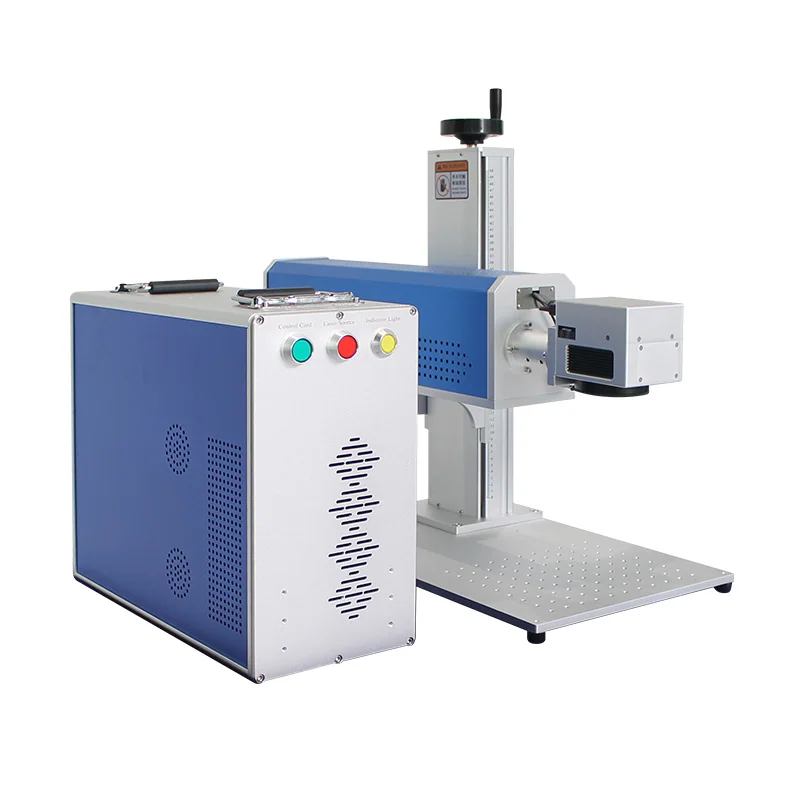
Key Specifications
Configuration overview
| Parameter | Specification |
|---|---|
| Laser Wavelength | 10.6 μm |
| Laser Type | CO₂ laser; tube type and source model specified in quotation |
| Power Options | 30 W / 60 W / 100 W |
| Marking Field | Lens and head dependent; field and working distance specified in quotation |
| Cooling | Source-dependent: water cooling for glass-tube configurations; RF source cooling per model |
Power options shown are the configurations described in this catalog. The quotation confirms availability, source model, optics, electrical requirements, dimensions and weight. Sample testing establishes achievable contrast, depth and cycle time.
Applicable Materials
Materials to evaluate on your parts
Check the composition of synthetic leather, rubber, plastics and coated packaging before processing. PVC and other unsuitable halogen-containing materials are excluded from this general recommendation. Glass may develop microcracks; direct marking of food requires separate process and suitability validation.
Marking Samples
What marking looks like
Send your own material for a free sample test and see the result on your part — before any purchase decision.
Available Power
Choose power for the marking task
Packaging & Fine Marking
Date codes, barcodes and fine marking on paper, film and thin materials.
Balanced Production
The common choice for wood, acrylic and leather marking at production speed.
Deep Engraving
Deeper engraving on wood, thick acrylic and denser non-metal materials.
CONFIGURE FOR YOUR PART
Optics, process & production planning
Explore the details that affect mark quality, part access and production cycle.
Choose the field for the marking artwork
Select the field for the size of the actual code or artwork, rather than the overall workpiece size. A larger field can change spot size, energy density and fine-detail performance. Lenses must match the wavelength, scanner and controller calibration.
| Requirement | Selection | What to confirm |
|---|---|---|
| Fine characters or small codes | Evaluate a smaller field | Readable characters, line width and contrast |
| Larger artwork | Evaluate a larger compatible field | Edge quality, focus and achievable cycle time |
| Curved or installed parts | Suitable fixture, rotary or focus arrangement | Surface geometry, positioning and access |
Lens changes require compatible optics, focus adjustment and field calibration. The confirmed field and working distance are listed for the selected configuration.
10.6 μm infrared: built for non-metals
The CO₂ source produces a 10.6 μm infrared beam that many organic materials and glass absorb. Controlled heating or material removal can create marks on suitable wood, paper, acrylic, leather and glass. Bare metals generally require a fiber source for direct marking; some coated, anodized or marking-compound-treated metals can be evaluated separately.
Source construction and cooling must be selected together. Glass-tube configurations require water cooling; an RF source may use air or water cooling according to its model. The quotation specifies the actual tube, power, cooling system and duty-cycle limits.
At a glance
- ▍10.6 μm infrared wavelength
- ▍Optimized for non-metals & organic materials
- ▍High-speed galvanometer scanning
- ▍Cooling matched to source model
Evaluate the finished mark and cycle time
Scanner travel speed is not the same as production throughput. Material, artwork, fill spacing, pass count, focus, target depth and loading time determine the finished-part cycle. Request a timed sample using the proposed machine configuration.
| Measure | How to evaluate |
|---|---|
| Scanner performance | Source, scanner, lens and control settings specified together |
| Mark location and repeatability | Validate scanner performance together with fixtures, focus and part loading |
| Production cycle | Time the actual artwork, required passes and handling on representative parts |
Applications
Where this machine earns its place
Wood & Bamboo Gifts
Logos and text on wood gifts, cutting boards and bamboo goods.
Acrylic & Glass
Engraved or frosted effects on suitable acrylic and glass, confirmed by sample testing.
Leather & Footwear
Detail and logo marking on leather, belts and shoe uppers.
Food & Packaging Codes
Batch codes and best-by dates on packaging, film and cardboard.
Glass Bottles
Frosted surface marking on suitable glass; inspect for chipping and microcracks.
Paper & Cardboard
Barcodes and logos on boxes, tags and printed materials.
Optional Accessories
Configure the setup for your application
Options are evaluated for the selected machine and application. Compatibility and included items are confirmed in the quotation.
Rotary or part fixture
Evaluate geometry, load capacity and controller compatibility.
Fume extraction
Select capture and filtration for the materials and process.
Interlocked enclosure
Specify an enclosure for the wavelength and complete configuration; system classification requires assessment.
Focus adjustment
Confirm the required part-height range and mechanism.
Production integration
Confirm sensors, controller interfaces, guarding and cycle requirements.
FAQ
Frequently asked questions
CO₂, fiber or UV — which laser do I need?
Start with the exact material and required effect. Fiber is commonly used for metal identification; CO₂ for suitable wood, acrylic, leather, paper and packaging; UV for fine detail on selected sensitive plastics and glass. Material testing determines the final choice.
Can a CO₂ laser mark metal?
Direct marking of bare metal generally calls for a fiber laser. CO₂ can mark some anodized or coated metals, or surfaces prepared with a compatible marking compound. These are different processes and require separate testing.
What about glass tubes and RF sources?
Glass tubes and RF sources differ in modulation, cooling, service requirements and duty cycle. Availability and performance depend on the selected model. The quotation must state the tube type, source model, power and matched cooling system.
Can it mark glass?
CO₂ can produce a frosted surface mark on suitable glass. Thermal stress can cause chipping or microcracks, so composition, wall thickness, curvature and settings must be tested. It is not a guarantee of crack-free processing.
Which power should I choose?
Evaluate 30 W for suitable packaging and fine marking, 60 W for general wood, acrylic and leather applications, and 100 W where greater removal rate is needed. Source modulation and material response also affect quality and cycle time.
How do I test it on my own parts before ordering?
Send representative parts, the material grade and coating details, your marking file, and the required contrast, depth and cycle time. We test the proposed configuration and share the result and process parameters before you order. Start a sample test →
Request a CO₂ quotation
Tell us your material, part size, production volume and marking content. We reply with a machine configuration, price and delivery plan.