Fiber Laser Marking Machine
1064 nm fiber laser for high-speed permanent marking on stainless steel, aluminum, brass, copper and other metals. 20 W to 100 W.
- Power options
- 20 / 50 / 100 W
- Wavelength
- 1064 nm
- Application
- Metals & traceability
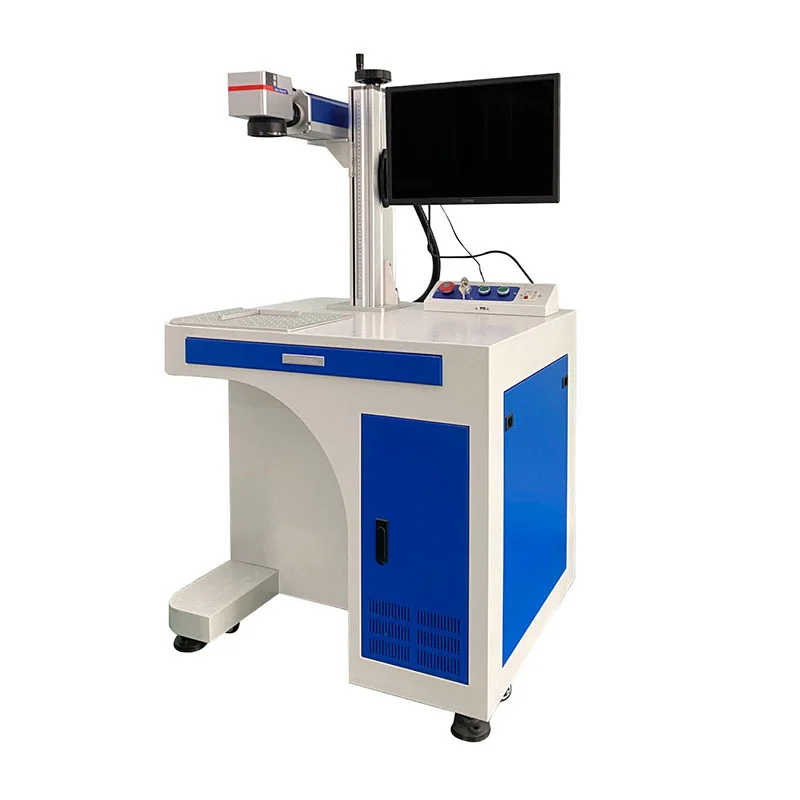
Key Specifications
Configuration overview
| Parameter | Specification |
|---|---|
| Laser Wavelength | 1064 nm |
| Laser Type | Pulsed fiber laser; source model specified in quotation |
| Power Options | 20 W / 50 W / 100 W |
| Marking Field | Lens and head dependent; field and working distance specified in quotation |
| Cooling | Air cooling |
Power options shown are the configurations described in this catalog. The quotation confirms availability, source model, optics, electrical requirements, dimensions and weight. Sample testing establishes achievable contrast, depth and cycle time.
Applicable Materials
Materials to evaluate on your parts
Plastic formulations, plated parts and reflective metals require testing. For medical parts, marking durability and corrosion performance must be validated for the intended cleaning and sterilization process.
Marking Samples
What marking looks like
Send your own material for a free sample test and see the result on your part — before any purchase decision.
Available Power
Choose power for the marking task
Marking & Light Engraving
Date codes, barcodes and fine marking on stainless steel, aluminum and plated metals.
Balanced Production
The common choice for metal marking and light engraving at production speed.
Deep Engraving
Deeper engraving on steel, brass, copper and other dense metal materials.
CONFIGURE FOR YOUR PART
Optics, process & production planning
Explore the details that affect mark quality, part access and production cycle.
Choose the field for the marking artwork
Select the field for the size of the actual code or artwork, rather than the overall workpiece size. A larger field can change spot size, energy density and fine-detail performance. Lenses must match the wavelength, scanner and controller calibration.
| Requirement | Selection | What to confirm |
|---|---|---|
| Fine characters or small codes | Evaluate a smaller field | Readable characters, line width and contrast |
| Larger artwork | Evaluate a larger compatible field | Edge quality, focus and achievable cycle time |
| Curved or installed parts | Suitable fixture, rotary or focus arrangement | Surface geometry, positioning and access |
Lens changes require compatible optics, focus adjustment and field calibration. The confirmed field and working distance are listed for the selected configuration.
1064 nm near-infrared: built for metals
The 1064 nm fiber source can mark metals by surface alteration or material removal, depending on the settings. Absorption varies by alloy, surface condition and wavelength; metals do not all absorb equally. Some formulated plastics and coated surfaces can also be marked, while wood and clear acrylic are generally better evaluated with CO₂.
The air-cooled source is configured for the application. The quotation identifies the laser source, power, scanner and lens; sample testing establishes the process window for your material.
At a glance
- ▍1064 nm near-infrared wavelength
- ▍Optimized for metals & metal alloys
- ▍High-speed galvanometer scanning
- ▍Air-cooled operation
Evaluate the finished mark and cycle time
Scanner travel speed is not the same as production throughput. Material, artwork, fill spacing, pass count, focus, target depth and loading time determine the finished-part cycle. Request a timed sample using the proposed machine configuration.
| Measure | How to evaluate |
|---|---|
| Scanner performance | Source, scanner, lens and control settings specified together |
| Mark location and repeatability | Validate scanner performance together with fixtures, focus and part loading |
| Production cycle | Time the actual artwork, required passes and handling on representative parts |
Applications
Where this machine earns its place
Stainless Steel Parts
Logos, serial numbers and barcodes on stainless steel hardware and tools.
Aluminum Components
High-contrast marking and engraving on aluminum housings and extrusions.
Brass & Copper
Detail and logo marking on brass fittings, copper parts and jewelry.
Automotive Parts
Batch codes and part numbers on engine components and brake pads.
Medical Instruments
Permanent identification marks on stainless steel medical tools and implants.
Metal Tags & Nameplates
Barcodes and logos on metal tags, nameplates and name badges.
Optional Accessories
Configure the setup for your application
Options are evaluated for the selected machine and application. Compatibility and included items are confirmed in the quotation.
Rotary or part fixture
Evaluate geometry, load capacity and controller compatibility.
Fume extraction
Select capture and filtration for the materials and process.
Interlocked enclosure
Specify an enclosure for the wavelength and complete configuration; system classification requires assessment.
Focus adjustment
Confirm the required part-height range and mechanism.
Production integration
Confirm sensors, controller interfaces, guarding and cycle requirements.
FAQ
Frequently asked questions
Fiber or MOPA — which should I choose?
Standard pulsed fiber is a common option for routine metal identification and engraving. Evaluate MOPA when adjustable pulse width is needed, including color effects on suitable stainless steel or titanium, dark marks on selected anodized aluminum, and control of heat input. Both can mark stainless steel; the required result should guide selection.
Can a fiber laser mark plastic?
Some grades of ABS, PC and other formulated plastics respond to 1064 nm fiber lasers. Additives, pigments and coatings affect the result, so the polymer name alone does not establish compatibility. UV may be preferable for some sensitive or transparent parts. Test the exact material first.
How deep can it engrave metal?
Depth depends on metal, power, lens, hatch settings, pass count and allowed processing time. There is no single depth rating for every configuration. Send the required depth and cycle time so we can test and recommend a suitable source and power.
Can it mark stainless steel?
Yes. Depending on the surface and settings, a fiber laser can produce annealed, light, dark or engraved marks. Wear resistance and corrosion performance depend on the process and must be checked against the intended use.
Which power should I choose?
Evaluate 20 W for routine identification, 50 W for production marking and engraving, and 100 W where greater removal rate is required. Power alone does not determine the result; sample testing confirms the proposed configuration and cycle time.
How do I test it on my own parts before ordering?
Send representative parts, the material grade and coating details, your marking file, and the required contrast, depth and cycle time. We test the proposed configuration and share the result and process parameters before you order. Start a sample test →
Request a Fiber quotation
Tell us your material, part size, production volume and marking content. We reply with a machine configuration, price and delivery plan.