AODEQI · BUYING & APPLICATION GUIDES
How to Choose the Right Laser Marking Machine: Complete Guide 2026
Choose a laser marking machine by material, mark quality, power, field size and production workflow. Includes a practical B2B buying checklist.
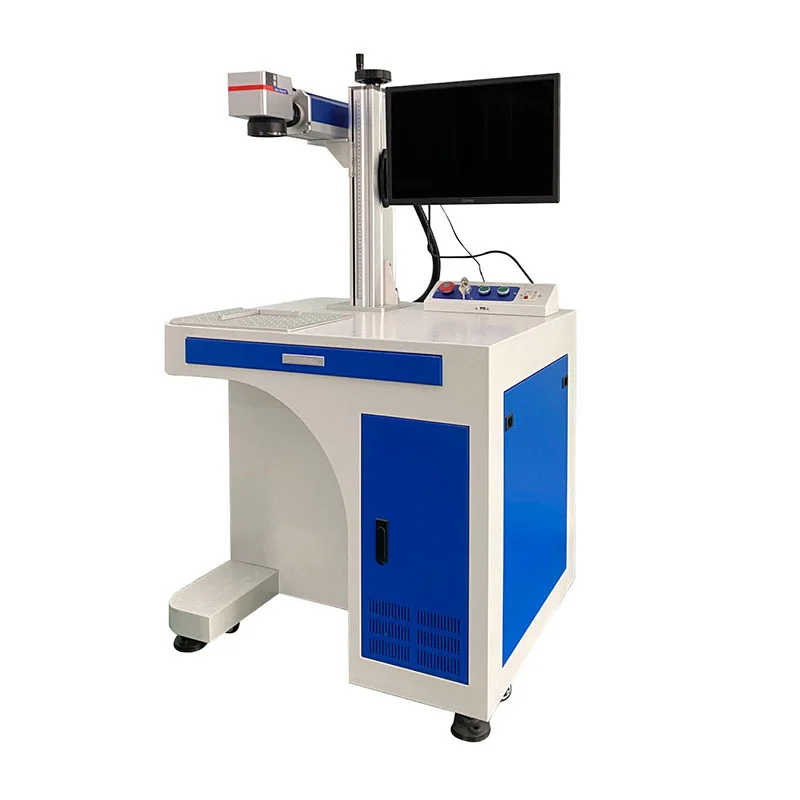
Buying a laser marking machine starts with a finished mark, not a wattage. A readable production code on a polished valve, a small identifier on a plastic connector and decorative engraving inside a ring require different decisions. This 2026 buying guide helps industrial purchasers turn those requirements into a testable specification. AODEQI offers Fiber, UV, CO₂, MOPA and Handheld configurations. The practical objective is to select a complete process that works on your parts, with an agreed acceptance method and a support plan.
Define the mark before selecting the source
Content, location and durability
Write down the information that must appear on the part: a logo, variable serial number, date, DataMatrix symbol or a combination. Include the available marking area, smallest character, orientation and required contrast. Explain whether the mark must survive cleaning, abrasion, coating or another downstream process. A mark that looks attractive immediately after processing may be unsuitable after finishing. Give the supplier representative parts and a drawing identifying the permitted marking location. Restricting the location matters when walls are thin or functional surfaces must remain untouched.
Match the technology to the actual surface
Source and surface compatibility
For many bare metal identification tasks, begin with a fiber laser marking machine. A UV laser marker is worth evaluating for sensitive plastics, glass and fine electronics identification. CO₂ marking is commonly considered for suitable wood, acrylic, leather and packaging. MOPA is a fiber-source architecture with additional pulse control, rather than a completely separate material category. A MOPA configuration can be useful when contrast or controlled metal surface effects require a wider process window. Test the exact grade, coating and finish; a material name alone is insufficient.
Choose power alongside the marking task
Power affects the process, but it does not independently determine finished throughput. A small serial number and a broad filled logo expose different amounts of surface. Deep engraving may require repeated passes, while identification can depend more on contrast and readable detail. The AODEQI catalog currently lists 20, 50 and 100 W Fiber configurations; UV configurations are 3, 5 and 10 W. These are starting points for quotation, not interchangeable performance promises. Ask which source, scanner, lens and control settings were used for the proposed result.
Size the field for the artwork and positioning
The workpiece can be much larger than the laser marking field. A large housing with a small identifier does not necessarily need a very large lens field. Conversely, a wide label or multiple separated marks may require a different optical or handling arrangement. Give the supplier the artwork dimensions and the allowed positioning tolerance. Confirm focus adjustment, working distance and access around fixtures. For cylindrical parts, evaluate a compatible rotary accessory. For curved surfaces, require a demonstration showing how focus and mark geometry remain acceptable across the actual marked area.
Measure the complete production cycle
Scanner travel speed is not a parts-per-minute specification. Record loading, locating, code transfer, marking, reading, unloading and any required cleaning. A fast laser process can still produce a slow workstation when an awkward component takes time to position. Ask for a continuous demonstration of the agreed sequence rather than an isolated close-up of the beam. If several parts share a fixture, confirm how the system identifies each position and handles missing or incorrectly loaded parts. Agree how rejected or unreadable codes will be detected and separated.
Select a workstation that fits the factory
A desktop system, enclosed workstation, integrated production station and handheld marker solve different access problems. Identify part weight, available floor space, power supply and the movement required around the workpiece. A handheld marking head does not by itself establish battery operation, an unrestricted outdoor duty cycle or a safe operating boundary. Confirm the selected configuration's supply requirements, guarding, interlocks and extraction. For any proposed production integration, document the signals and responsibilities that belong to the machine supplier and those that belong to your own integrator.
Compare quotations on the same scope
Request an itemized quotation that identifies the source, rated power, wavelength, optics, controller, software, enclosure, fixture, extraction and any rotary accessory. Ask whether installation guidance, training, shipping documents and spare parts are included. Compare the named trade term and destination rather than comparing a factory collection quotation with a delivered shipment. Review the shipping policy and warranty terms, then have any order-specific differences written into the accepted sales documents. A low initial price is difficult to assess when essential accessories are left undefined.
Agree an acceptance test before placing the order
Create a short approval sheet with the part identification, artwork revision, permitted location, contrast or code-quality requirement and complete cycle target. Include after-processing checks where the mark will be cleaned, sterilized or coated. Keep an approved physical sample and the associated test record. State which changes require a new approval, such as a different resin, coating, source or lens. Acceptance should establish what was tested and what is being supplied; it should not rely on a generic claim that a machine works on every metal or plastic.
Prepare a useful request for quotation
Send the material grade, coating, part dimensions and weight, marking file, production quantity and destination country. Include photos of the available work area and describe any conveyor, database or reader integration. Identify who will judge the result and what evidence they need. With that information, AODEQI can discuss a suitable configuration and arrange a sample test. The strongest buying decision connects a documented marking result to a clearly defined machine and delivery scope, making the quotation easier to compare and the eventual installation easier to approve.